FlywheelBrander logo

The content operating system for founder-led B2B teams that want stronger autonomy without losing control

FlywheelBrander turns strategy posture, signal, queue movement, review boundaries, scheduling, and commercial alignment into one supervised operating layer. Strong where it is earned. Explicit where it remains bounded.

Best fit: founder-led B2B teams with strong product truth, inconsistent content operations, and little patience for generic AI tooling or inflated autonomy language.

Who it is for

Teams that know their product and market, but still need a repeatable operating layer for signal, content decisions, review, and distribution.

What gets stronger

Strategy posture, queue movement, scheduling readiness, and commercial coherence become easier to run as one system instead of scattered decisions.

What stays bounded

Outbound and queue-changing actions remain approval-aware, support tiers stay public, and claims stay inside proof that can actually be shown.

Public proof blocks make the promise legible

The public surface should not ask buyers to trust adjectives. FlywheelBrander keeps capability truth, bounded autonomy language, and demo-safe evidence visible before stronger commercial claims are made.

LinkedIn
Bluesky
X
Instagram
YouTube
Newsletter
CMS blog
Podcast

Public capability matrix

Execution-bounded, preparation-only, and planning-only support tiers stay public so capability truth does not drift from runtime reality.

8 execution-bounded · 1 preparation-only · 0 planning-only

ChannelSupport tierPlanningPreparationPublishingApprovalAnalyticsVerification

Bluesky profile

bluesky profile

Execution-boundedLiveLiveLiveApproval-gatedProvider-limitedLive

LinkedIn personal profile

linkedin personal

Execution-boundedLiveLiveLiveApproval-gatedApproval-gatedApproval-gated

LinkedIn company/page

linkedin company page

Execution-boundedLiveApp-managedApp-managedApproval-gatedProvider-limitedProvider-limited

Newsletter publication

newsletter publication

Execution-boundedLiveApp-managedApp-managedApproval-gatedProvider-limitedProvider-limited

Website / CMS blog

cms blog

Execution-boundedLiveApp-managedApp-managedApproval-gatedProvider-limitedApp-managed

X profile

x profile

Execution-boundedLiveApp-managedApp-managedApproval-gatedProvider-limitedProvider-limited

Instagram profile

instagram profile

Execution-boundedLiveApp-managedApp-managedApproval-gatedProvider-limitedProvider-limited

YouTube channel

youtube channel

Execution-boundedLiveApp-managedApp-managedApproval-gatedProvider-limitedProvider-limited

Podcast series

podcast series

Preparation-onlyLiveApp-managedPlannedApproval-gatedPlannedPlanned

Proof center

Open the bounded-autonomy reference when a buyer needs the exact claim boundary, not just the headline.

Review proof center →

Safe claims

Use the demo-safe narrative when the conversation moves from curiosity into evaluation and objection handling.

Open demo-safe claims →

Commercial path

Route serious buyers into self-serve, guided pilot, or higher-touch commercial conversation from real fit, not funnel guesswork.

Find your best commercial path →

Capability-aware commercial routing

Choose whether to self-serve or start a qualified pilot based on real support/capability fit.

Recommended route

Start with qualified guided pilot

Guided pilot is the safest default for teams that need practical momentum, clearer support boundaries, and truthful supervised rollout.

Commercial offer now

Guided pilot as the primary commercial motion for serious founder-led teams.

Pilot scope now

Scope includes guided kickoff, explicit expectations, week-one momentum goals, and bounded rollout supervision.

Readiness segment

Pilot-ready now for qualified teams; broad launch remains explicitly gated.

Launch gate

Launch gate tied to fit qualification, supervised operating proof, and stable bounded execution posture.

  • Your profile fits a guided pilot start for faster first momentum with explicit expectation-setting.
  • This preserves capability truth while reducing rollout ambiguity.

Strongest pilot use cases

  • Teams that need first momentum with clear support boundaries
  • Buyers wanting credible pilot structure before broader commitment

Guarded or staged use cases

  • Universal self-serve assumptions across all team profiles
  • Claims of fully autonomous launch without guided qualification

Guided pilot improves conversion quality without claiming channel/provider parity beyond what runtime truth supports.

CTA guardrails keep route destinations bounded to capability, pricing, pilot, docs, and authenticated-entry truth surfaces instead of open-ended funnel drift.

What a serious buyer is actually buying now

FlywheelBrander now makes the offer explicit: guided pilot first for most serious rollout paths, with launch-gating discipline to prevent scope promises that outrun supervised runtime truth.

Offer now

A supervised content operating system with guided pilot as the primary serious rollout motion.

Pilot scope now

Guided kickoff, expectation-setting, week-one momentum goals, and explicit support boundaries.

Launch gate

Broader launch remains gated until fit, supervision posture, and rollout readiness are clearly proven.

Pilot-ready now

Founder-led B2B teams with strong product truth and urgency for supervised momentum.

Pilot-ready with constraints

Teams with higher complexity that need phased onboarding and stronger support alignment.

Guarded for later

Hands-off-from-day-one expectations or broad self-serve assumptions that outrun current truth.

Mechanical growth engine illustration

Not another AI content tool.A supervised operatingsystem with real boundaries.

  • One operating layer across signal, queue, strategy, scheduling, and commercial posture

  • Explicit approval on outbound and queue-changing actions

  • Public capability truth that does not change with pricing language

  • Proof surfaces and docs that explain why claims stay bounded

  • Guided pilot motion for teams that want calm rollout, not AI theater

How the public story should be demonstrated

The best walkthrough is not feature-dump first. It should move from category and claim boundary, into proof, then into the premium surfaces in the order that makes buyer sense.

Position

  • Open with category, buyer fit, and bounded autonomy
  • Explain what FlywheelBrander is before showing features

Prove

  • Use proof center, capability matrix, and safe claims
  • Show why trust comes from runtime truth, not adjectives

Operate

  • Walk the dashboard, calendar, strategy, settings, and Commercial Ops flow
  • End with the CTA that fits current rollout maturity

Trust comes from proof surfaces, not hype language

FlywheelBrander already has stronger product truth than the public page communicated. This section makes the trust model explicit: public proof, bounded claims, and commercial packaging all point back to the same runtime reality.

  • Proof center tied to real bounded autonomy
  • Capability matrix with execution-bounded, preparation-only, and planning-only support
  • Pricing that changes support depth, not capability truth
  • Demo-safe claims that stay inside current runtime evidence
Live monitor dashboard showing agent activity workflow
Pipeline process visualization

A landing page that supports the demo conversation

A serious evaluation should be easy to stage: first explain the category, then the claim boundary, then the proof, then the product, then the next commercial step.

1

Start with the public promise: supervised content operations for founder-led B2B teams

2

Set the claim boundary: strong bounded autonomy, not hands-off marketing

3

Show proof: capability matrix, proof center, and safe-claim docs

4

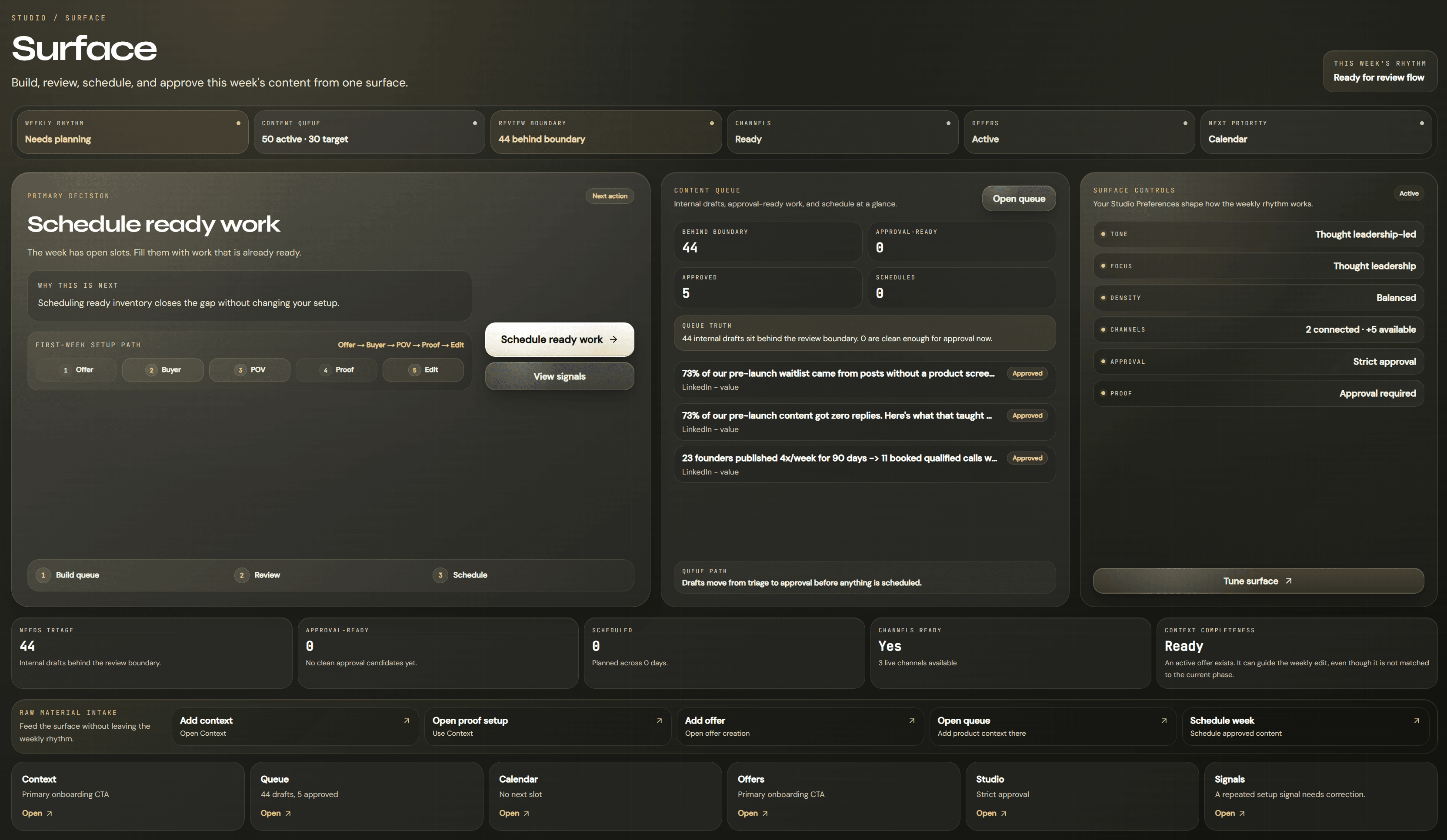
Open the dashboard and explain posture, next actions, and queue truth

5

Walk calendar, strategy, settings, and Commercial Ops in that order

6

Close with the right CTA: self-serve path, guided pilot, or commercial conversation

When the right next step is a guided pilot

Guided pilot is the primary CTA because the product is commercially serious and operationally strong, but still best introduced through a structured rollout instead of a vague “start anywhere” promise.

  • Lead with the category and the bounded claim
  • Show proof before making stronger autonomy language
  • Walk the premium surfaces in operator order, not feature order
  • End with the commercial next step that fits current rollout maturity
Start pilot intake
Dashboard preview

The public story now points to the same surfaces the product already defends

Proof center

Capability truth

Demo-safe claims

Guided pilot motion

Founder early access illustration

What the current CTA structure is designed to do

Public CTA structure should match the product’s real maturity: one primary motion for serious rollout, bounded exploratory paths for buyers still evaluating, and no false impression that every visitor should self-serve immediately.

  • One clear primary CTA for serious teams: guided pilot intake
  • Secondary exploration paths for pricing, proof, and capability truth
  • Expectation-setting that matches supervised rollout maturity
  • Commercial routing that stays bounded to real support and capability fit

What a stronger market-facing presentation now makes clear

Positioning clarity

Serious buyers can understand category, fit, and autonomy boundary in a few lines instead of decoding generic AI language.

Guided pilot track

Founder-led B2B teams

Proof-led trust

Claims are supported by a proof center, public capability truth, and demo-safe framing instead of soft adjectives.

Guided pilot track

Founder-led B2B teams

Disciplined next step

Visitors can move into the right path - guided pilot, pricing review, or route selection - without CTA confusion.

Guided pilot track

Founder-led B2B teams

Commercial FAQ

What category does FlywheelBrander belong to?

FlywheelBrander is a premium content operating system for founder-led B2B teams. It combines strategy posture, queue operations, review boundaries, commercial alignment, and distribution decisions into one supervised workflow.

How autonomous is FlywheelBrander today?

It is strong in bounded, supervised autonomy. The system recommends, prepares, and routes work with policy awareness, while operators keep explicit approval over outbound and queue-changing actions.

What should a serious buyer review first?

Start with the landing-page positioning, then review the proof center, public capability matrix, and demo-safe claims guide. Those three surfaces show what is strong now, what remains bounded, and how the product should be evaluated honestly.

Why is guided pilot the recommended motion right now?

Because the product is mature enough to create real momentum, but still strongest when rollout expectations, approval boundaries, and proof interpretation are set deliberately. Guided pilot keeps that commercial conversation honest.

What does FlywheelBrander not promise yet?

It does not promise fully hands-off autonomous marketing. It does not replace operator judgment on quality, fit, or brand truth. It does not use pricing or landing-page language to imply unsupported channel parity or hidden authority.